
How Much Does Website Design Cost in NZ? 2026 Pricing, Explained
BLOG
The honest numbers behind a website quote: what drives the cost up, what a cheap one leaves out, and how to tell which tier is right for your business.

Web design fees in NZ run from a few hundred dollars a year on a do-it-yourself platform to $20,000 and beyond for a custom build. In 2026, most small businesses hiring a professional land somewhere between $3,000 and $12,000, and the spread is not noise. Those figures describe genuinely different products, built to do different jobs.
Many business owners budgeting for a new website start with a number picked up from an ad or a mate’s invoice, and it rarely survives contact with a real quote. The question everyone starts with, how much does a website cost in NZ, has no single answer, because a website is not a single product. What it actually costs to build a website in New Zealand depends on the type of website you need, who builds it, and how much of the work is real design rather than configuration.
This article sets out what 2026 pricing actually looks like: the brackets, the models, what moves a quote up, and the costs that keep arriving after launch. We design and build websites for a living, and our own numbers are in here too, because a cost guide that hides its own figures is part of the problem. Whoever ends up doing your web design, you should be able to read their quote and see what is missing from it.
Yearly budget for a website builder like Wix or Squarespace
Template build from a freelancer or studio
Fully custom design and build
Website Pricing in NZ: Three Brackets for Small Businesses
The market splits into three broad brackets, and each one buys a different product. A do-it-yourself builder gives you the platform and leaves you the work: you assemble the site from templates, on your own evenings. A template build hands that work to a freelancer or small studio, and what comes back depends on how much gets customised. A fully custom project adds discovery, original design work and engineering, which is why that bracket opens so much wider than the other two.
The web design fees quoted through this article are indicative New Zealand dollar figures, drawn from publicly advertised rates and our own quoting. These ranges hold for small to medium businesses. Enterprise and government work follows different rules and is not what this article is about. For a small business website, the middle and upper brackets are where most professional quotes land, so compare the scope behind a number rather than treating any range as a market average.
What Affects the Cost of a New Website
A website quote moves on a handful of levers, and it pays to know which ones you are pulling. In any web design project, the biggest cost is skilled time, so anything that needs more of it adds to the bill:
- Scope. The number of pages matters, but less than people assume. A five-page website with clear goals can outperform a sprawling one.
- Design depth. A tweaked template is cheap. The more of the design that is drawn from scratch for your brand, the higher the cost, and the complexity of the design drives build time too.
- Functionality. A contact form is standard. An online booking system, a members’ area or custom integrations mean real development work, and full web applications sit in another bracket again.
- Content. Someone has to write the pages and prepare the images. If it is not you, it is in the quote, and if it is not in the quote, it is you.
- The level of customisation behind the scenes. A custom website is quoted on what has to be designed and engineered, not on page count alone.
Two quotes that look identical on paper can sit at opposite ends of these levers. That is why comparing quotes by the number alone tells you almost nothing. We see it in our own quoting: the same five pages can sit at the bottom of a tier when the client brings finished copy and photography, and a tier higher when we are writing the content, drawing custom illustration or wiring in a CRM. Those requirements move a quote far more than an extra page or two.
Where the Money Goes in a Website Project
Discovery
The questions before any design: goals, customers, content, what the site must actually do. In our quotes, often 10 to 15 percent of the total, and the step cheap builds skip first.
Design
Layouts, look and feel, mobile versions, revision rounds. Roughly a quarter of the work on our projects, more when the design is fully bespoke.
Build and QA
Turning designs into a working site, then testing it on real devices before anyone sees it. Usually the largest share of the quote.
Content and SEO Basics
Loading pages, fitting copy, titles and descriptions, analytics. A small line with a big effect on whether anyone finds the site.
Launch and Handover
Going live, training, a warranty period. Most professional builds land four to sixteen weeks after kickoff, depending on scope and how fast content and feedback arrive.
What Web Designers Charge: Common Pricing Models
What web designers in New Zealand charge usually comes packaged one of three ways. A fixed quote for a defined scope is the most common for full builds, and the easiest to compare, provided the scope is actually written down. Hourly rates, generally $90 to $180 depending on seniority, are fair for small jobs and ongoing work, but harder to budget for a full build. Monthly subscription is the third: the web design packages advertised at $99 a month or similar, where the entry figure looks painless until you read who owns the site when you stop paying. Depending on the contract, the answer may not be you.
A few designers still charge per page, which sounds tidy but mostly rewards padding. And the location premium is real: Auckland agencies typically charge more than a solo freelancer, partly overheads, partly team depth, and a bigger team is genuinely worth paying for on some projects and genuinely not on others.
Whatever web design pricing you are offered, the scope attached to it matters more than the model itself. A fixed quote with a vague scope is just an hourly bill you have not received yet.
THE YEAR-TWO TESTA $2,000 build with no plan for updates, backups, or support is not a $2,000 website. It is year one of a more expensive one. Before comparing quotes, ask what each site will cost you across two years, hosting and upkeep included. The cheapest build on that number is rarely the cheapest quote in the pile.
DIY vs Professional Web Design:
What Each Really Costs
Building Your Website Yourself
A DIY platform is the fastest way to get a website up and take your business online, and for some it is the right call. A sole trader with more word-of-mouth work than the diary can hold may only need a tidy page with services, photos and a number. The subscription is not the real cost, though. Your time is. Evenings fighting templates are evenings not spent on paying work, and the result usually still looks like what it is.
Hiring It Done
Paying a professional buys discovery, custom design work and accountability: someone whose job it is, through the build and the warranty period, when the contact form breaks or the pages slow down. It also buys judgement, which is the difference between a site that looks fine and one that turns visitors into enquiries. You pay thousands instead of hundreds. What you get back is your evenings, and a site shaped around how your customers actually buy from you.
Got a Quote You Are Not Sure About?
Bring it to a free discovery session. We will tell you what is in it, what is missing, and whether the number is fair for the scope. Plain answers, no strings.
Book a Free Discovery SessionWebsite Design Costs by Type:
Brochure Site or Online Store
A Brochure Website
Five to ten pages that explain who you are, what you do and how to get in touch. This is the shape most NZ businesses actually need: services, proof of work, clear ways to make contact. Most of the market’s $1,500 to $12,000 quotes describe some version of this, and the spread comes down to design depth and content. You can add online booking later if the business grows into it.
An E-Commerce Store
Selling products online changes the build entirely. A shopping cart, payment gateways, shipping and GST logic, product templates and stock management all need setting up and testing properly. Expect to pay from around $5,000 for a simple store on an established platform, and from $15,000 and up once custom design and deeper integrations enter the scope. Budget for payment processing fees as a permanent running cost from the day you launch.
What a Suspiciously Cheap Quote Leaves Out
Website development is skilled work, and skilled work has a floor price. A quote sitting far below the market is not a bargain, it is a shorter list of what you are getting. The usual gaps: one round of revisions, no discovery, a stock template with your logo dropped in, content left to you, no real testing before launch, and hosting that renews at three times the teaser rate after the first year. None of that appears on the quote. That is what hidden fees look like in this industry: not fake charges, just real work quietly moved to later, when it costs more.
Two questions strip most of it out. First, ask whether the price includes GST, because plenty of quotes are exclusive and 15 percent is a real difference at these numbers. Second, ask who owns the site, the domain and the files if you ever leave. If the answer takes more than a sentence, the advertised figure and the final cost are not the same number.
CONTROL YOUR DOMAINFor a .nz address, the Domain Name Commission recommends checking that your business is listed as the registrant, because the registrant is the party that controls the domain.
A cheap site that has to be rebuilt in eighteen months could cost more than building it properly once. Whoever you pick to build your website, have them walk you through the quote line by line. A good designer will happily do it. If they will not, that is your answer.
The Ongoing Costs
After Launch
The build quote is not the whole cost. A working site carries running costs, and a fair provider itemises them up front:
- Web hosting in NZ: roughly $15 to $50 a month for a business site, more for stores.
- A domain name: around $30 to $50 a year.
- An SSL certificate: usually included with decent hosting now, but confirm it. The padlock is not optional.
- Upkeep: updates, backups and security, from about $50 a month to $300 and up for active support. This is what website maintenance plans cover, and we have written a plain guide to what a care plan includes.
- Content updates and search engine optimisation (SEO) as the business grows, if and when you want them.
These ongoing costs are small compared to the build, but they are permanent, and a quote that never mentions them leaves you to find out later.

Is a Professional Website Still Worth It in 2026?
With AI page builders and cheap templates everywhere, it is fair to ask whether investing in a professional build still makes sense. The answer comes down to what the site has to do. A website is the centre of your online presence: the place your Google profile, your reviews and any digital marketing spend such as Google Ads all send people. If it converts those visits into enquiries, it pays for itself quietly, month after month. If it does not, every dollar spent sending traffic to it works at a discount.
That makes the return on your investment straightforward to reason about, the same as any other business cost: what a new customer is worth to you, against what the site costs to win them. A professionally built website that brings in two or three good jobs a month does not need a spreadsheet to justify itself. For a Kiwi business whose customers check them out online before ringing, that bar is lower than most owners think.
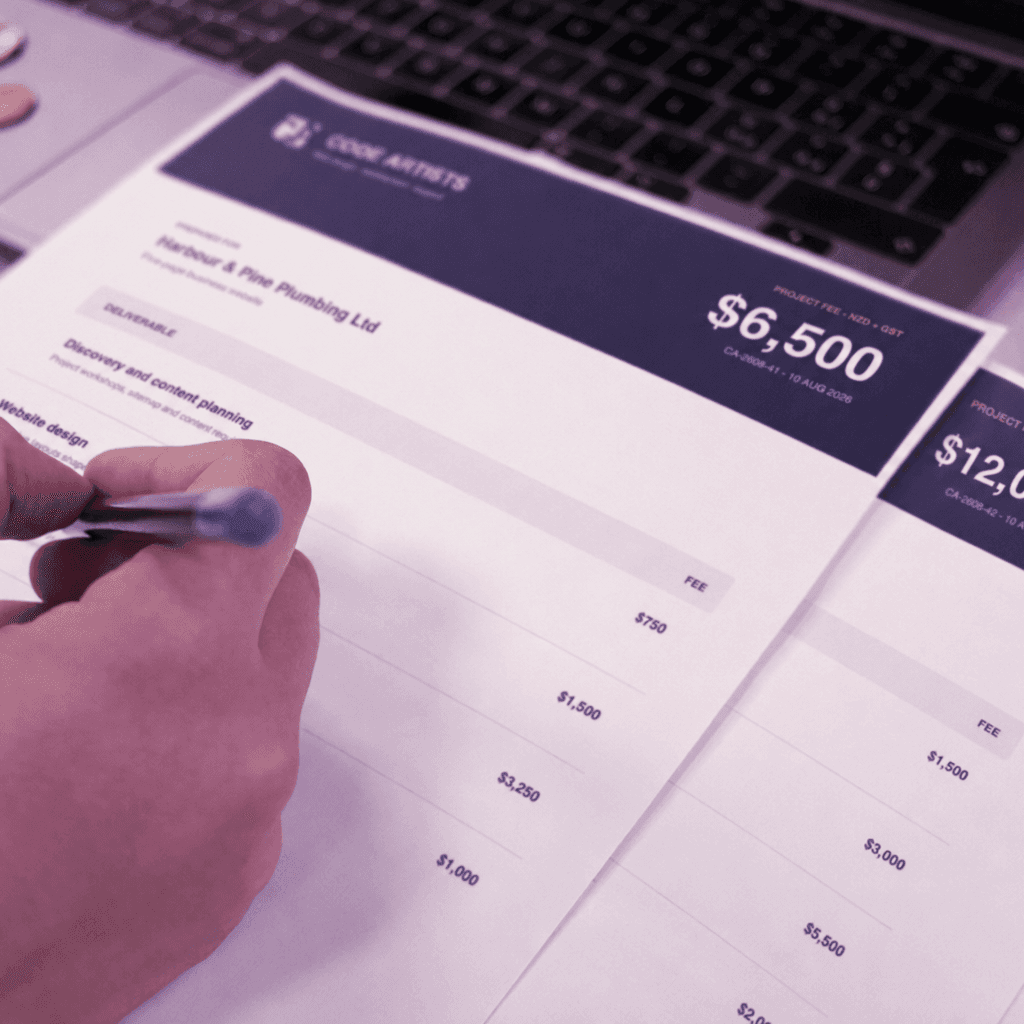
Not every business needs a $12,000 website. Plenty need a very good $6,500 one, and some genuinely need a $300-a-year one while they build word of mouth. The best value is the quote whose scope matches your business goals for the next few years, not the biggest or smallest number in the pile.
Our own numbers are public, tier by tier, on our pricing page: Website Lite at $6,000 to $7,000 for up to five pages, Standard at $10,000 to $12,000 for up to ten, and store builds from $15,000. Code Artists is an Auckland studio, and we publish those numbers for the same reason this article exists: you should not have to get on a call to find out what things cost. Hold any quote you get, including ours, to the standard this article sets.
Know Exactly What You're Paying For
Bring a quote you have been given, or just an idea of what you need, and we will map the scope and the numbers in plain language. No pressure, no jargon.
Book a Free Discovery Session